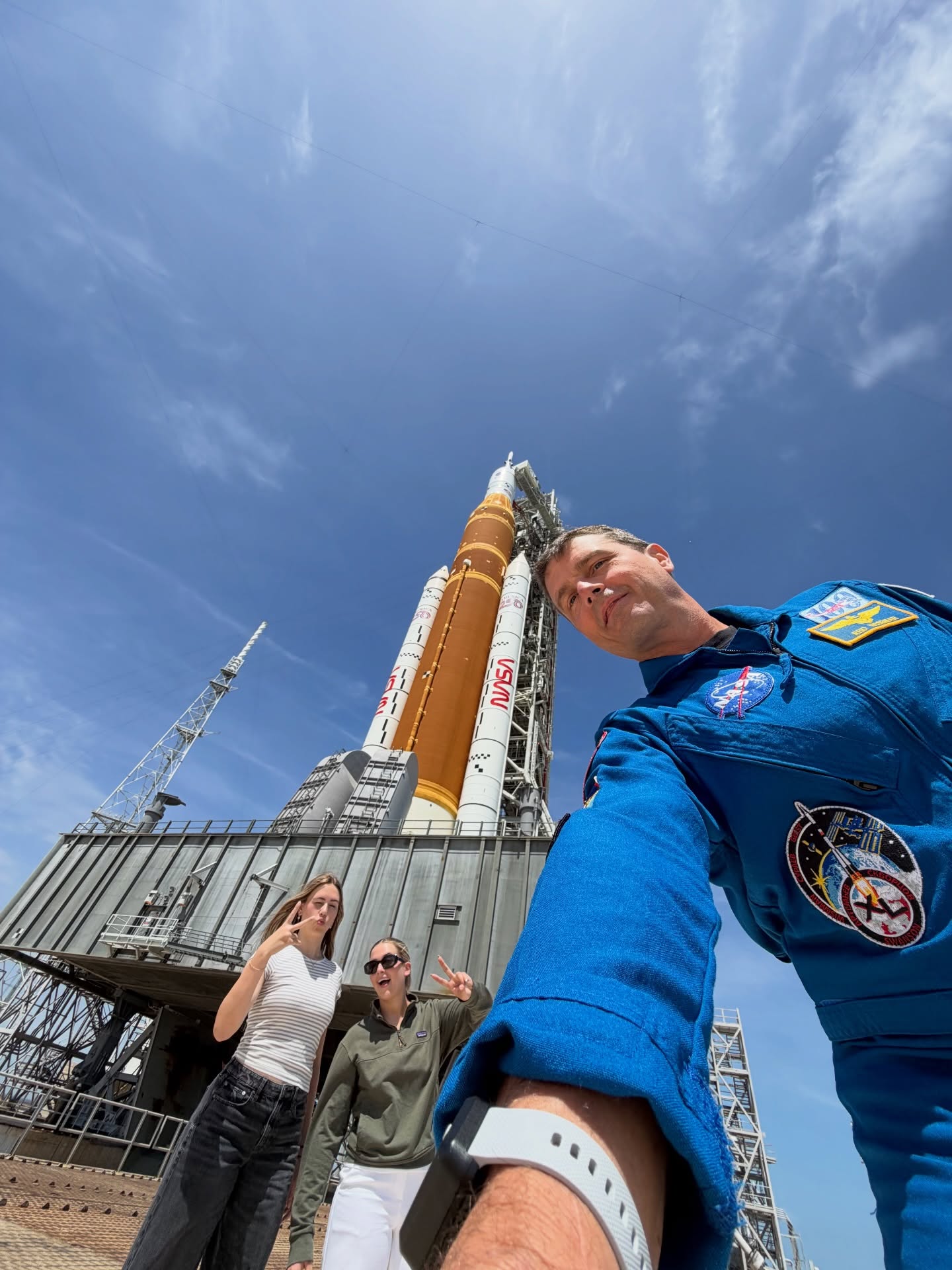
As NASA's Artemis II mission makes history by sending humans farther into space than any crew in decades, one of its most unforgettable moments didn't come from a technical breakthrough-but from a deeply human tribute that has touched hearts around the world.
In the quiet vastness of space, as astronauts gazed down at the Moon, a simple decision turned into something profoundly emotional. A previously unnamed crater became more than just a feature on the lunar surface-it became a symbol of love, loss, and remembrance.
And at the center of that moment was one question many are now asking:
Who was Reid Wiseman's wife, and why did her name echo all the way to the Moon?
A Moment That Moved the World
During the mission, the Artemis II crew-Reid Wiseman, Victor Glover, Christina Koch, and Jeremy Hansen-spotted a series of craters on the Moon's surface. As they discussed potential names, the tone shifted.
Mission specialist Jeremy Hansen, visibly emotional, addressed Mission Control and said:
"We lost a loved one... her name was Carroll."
Sitting beside him, Wiseman wiped away tears. What followed was a moment rarely seen in space exploration-raw emotion, shared grief, and deep respect. The crew proposed naming one of the craters "Carroll", in honor of Wiseman's late wife.
The crater, described as a bright spot visible from Earth at certain times, now carries a meaning far beyond science. It has become a lasting tribute to a life that impacted many-quietly but powerfully.
Who Was Carroll Wiseman?
Carroll Taylor Wiseman was not a celebrity, but her life was marked by purpose, compassion, and service.
She dedicated her career to caring for others as:
- A registered nurse
- A pediatric nurse practitioner
- A caregiver for children in critical need
She worked in several respected medical institutions, including Children's Hospital of the King's Daughters in Virginia, before later serving as a school nurse in Maryland and Texas.
Born in Virginia Beach, Carroll built a life centered on helping others-especially children. Those who knew her remember not just her skill, but her gentle presence and unwavering dedication.
But beyond her profession, she was:
- A wife, married to Reid Wiseman since 2003
- A mother to two daughters, Katie and Ellie
- A cornerstone of her family's life, even as her husband pursued a demanding career at NASA
A Quiet Battle with Cancer
While Reid Wiseman trained for missions that would take him beyond Earth, Carroll was facing a battle much closer to home.
For five years, she fought cancer-a journey marked not by public attention, but by quiet resilience.
On May 17, 2020, at just 46 years old, Carroll passed away.
Her loss left a profound impact-not only on her family, but on the close-knit astronaut community that had come to know her.
Life After Loss
For Wiseman, the years following her passing brought a new reality.
He became a single father, raising their two daughters while continuing his work with NASA. He has openly described this season of life as both his greatest challenge and his most meaningful role.
Shortly before launching on Artemis II, he shared a heartfelt message alongside a photo with his daughters:
"I love these two ladies. I'm boarding that rocket a very proud father."
It's a reminder that behind every astronaut is a deeply human story-one shaped by love, sacrifice, and perseverance.
Why the "Carroll" Crater Matters
The proposed "Carroll" crater is not yet officially recognized. NASA has confirmed that the name will be submitted to the International Astronomical Union, which governs official naming of celestial features.
Still, the significance of the moment has already resonated globally.
The crater itself is described as a bright, visible point on the Moon, a detail that many have found symbolic. For those following the story, it represents something deeper:
A life that brought light to others... now remembered as a light in the night sky.
Alongside "Carroll," the crew also proposed naming another crater "Integrity," after their spacecraft-tying together the mission's purpose and its personal meaning.
Why This Story Resonates So Deeply
In an era of rapid headlines and constant updates, this moment stands apart.
It's not about controversy or spectacle. It's about something timeless:
- Love that continues beyond loss
- Community that honors one another
- A legacy that reaches farther than anyone could have imagined
The image of astronauts-floating in space, embracing through tears-has struck a chord because it reveals something we don't often see in moments of historic achievement:
Vulnerability.
A Faith Reflection on Legacy
There's something quietly profound about a name spoken in remembrance-especially in a place as vast as space.
For many, this moment reflects a deeper truth often rooted in faith:
that a life lived in love and service doesn't simply end-it echoes.
Carroll Wiseman spent her life caring for others, particularly children who needed compassion the most. And now, her story continues-not just through her family, but through a tribute written into the sky itself.
It's a reminder that even in loss, there can be meaning. And even in grief, there can be something enduring.
A Legacy That Reaches Beyond Earth
The Artemis II mission will be remembered for pushing boundaries, for rewriting what's possible in space exploration.
But for many, it will also be remembered for something far more personal:
A moment when a crew paused...
A name was spoken...
And love found its way into the stars.
Because sometimes, the most powerful stories aren't about how far we travel-
But about who we carry with us along the way.


